
TL;DR:
- EU law makes sellers responsible for a mandatory two-year warranty on electronics.
- The legal guarantee covers defects present at delivery, not user-caused damages or wear.
- Consumers should contact sellers directly and document issues to effectively enforce their rights.
Most electronics buyers in Europe assume their warranty comes from the manufacturer. That assumption could cost you time, money, and a working device. EU law places the responsibility squarely on the seller, not the brand that made the product, giving you a mandatory 2-year legal guarantee that applies to virtually every electronics purchase across member states. This guide walks you through what that guarantee actually covers, how it differs from optional commercial warranties, how to file a claim step by step, and what remedies you can expect, including the newest right-to-repair rules that took effect in 2026.
Table of Contents
- What does a warranty mean for electronics in Europe?
- What does the legal guarantee cover—and not cover?
- How to make a warranty claim for electronics
- Remedies, right to repair, and what happens after a successful claim
- Why most electronics buyers overlook their real warranty power
- Find electronics with confidence at OnlineStore24 EU
- Frequently asked questions
Key Takeaways
| Point | Details |
|---|---|
| Seller is responsible | Under EU law, your warranty is enforced by the seller, not the manufacturer. |
| Minimum 2-year coverage | Nearly all new electronics are covered by a 2-year legal guarantee across Europe. |
| Claims must be prompt | Notify the seller as soon as an issue appears to ensure your rights are protected. |
| Repair first, then refund | Your primary remedies are repair or replacement, with refunds only if earlier steps fail. |
| Extra warranties are optional | Commercial warranties offer extra benefits, but never replace your basic legal guarantee. |
What does a warranty mean for electronics in Europe?
Now that you know there's more to electronics warranties than meets the eye, let's clarify what these terms actually mean for your purchase.
When you buy a smartphone, laptop, or smart home device in the EU, you automatically receive what the law calls a legal guarantee of conformity. This is not a marketing promise. It is a binding right. EU consumers benefit from a mandatory 2-year legal guarantee, meaning the product must work as described, be fit for its intended purpose, and match any sample or model shown to you at the time of sale.
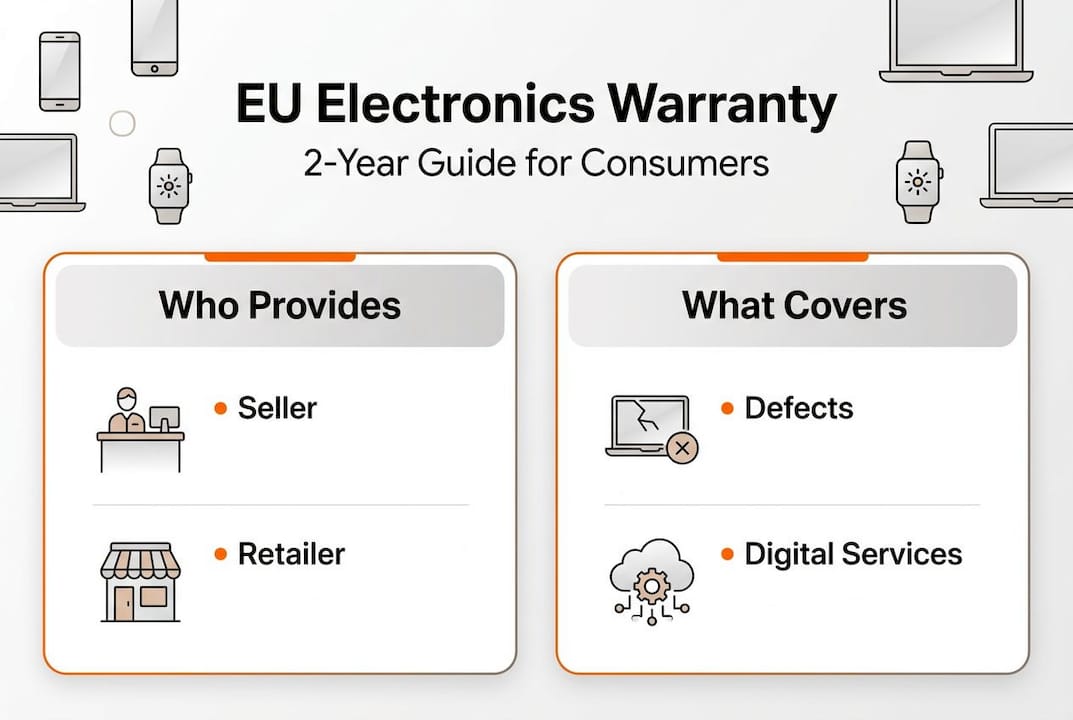
A product is considered "defective" when it fails to meet any of those conditions. That includes physical faults, software issues, and even missing features that were advertised. The key thing to understand is that this guarantee runs between you and the seller, not the manufacturer. If your TV stops working in month 14, you contact the retailer, not the brand.
This is where many buyers get confused. There are actually two types of warranty protection:
| Type | Who provides it | Duration | Legally binding? |
|---|---|---|---|
| Legal guarantee | Seller (retailer) | 2 years minimum | Yes |
| Commercial warranty | Manufacturer (optional) | Varies | No (contractual only) |
The distinction between legal and commercial warranties is critical because it determines who you contact and what remedies apply. Commercial warranties can offer useful extras, like extended coverage or accidental damage protection, but they cannot replace or reduce your legal rights.
Starting in 2026, harmonized EU disclosure rules require sellers to clearly state both types of warranty at the point of sale. This means you should always see the legal guarantee information before you complete a purchase. If you want to understand more about the broader EU electronics advantages of buying within the single market, those rules are part of a larger consumer protection framework.
Coverage applies to a wide range of products:
- Smartphones, tablets, and laptops
- Smart TVs and audio equipment
- Kitchen appliances and home devices
- Connected and smart home gadgets
- Software bundled with hardware
- Digital services that are part of the product
Two edge cases worth noting: used goods purchased from a seller (not a private individual) carry a minimum 1-year guarantee, and products bought from non-EU sellers may not be covered unless the seller actively markets to EU consumers. For a broader look at product categories, our consumer electronics guide covers what qualifies and what to look for.
Key takeaway: Your legal guarantee is automatic, free, and enforced against the seller. You do not need to register a product or pay extra to activate it.
What does the legal guarantee cover—and not cover?
With the basics in hand, let's look at the real-world protection you gain and the situations where you need to be careful.
The EU legal guarantee covers any lack of conformity that existed at the time of delivery. In practice, that means the following types of issues are covered:
| Issue type | Covered? |
|---|---|
| Physical defect (broken screen, faulty port) | Yes |
| Software failure present at delivery | Yes |
| Missing promised software updates | Yes |
| Device not matching its description | Yes |
| Accidental damage caused by the user | No |
| Normal wear and tear | No |
| Damage from misuse or unauthorized repair | No |
| Known defect disclosed before purchase | No |
Coverage includes electronics, smart devices, and digital services when they are part of the product. However, software defects caused by user-initiated updates are excluded. If you installed a third-party firmware that caused your device to malfunction, the seller is not obligated to fix it for free.

Country-level variations also matter. Sweden provides a 3-year legal guarantee for many electronics, and Norway, while not an EU member, offers coverage of up to 5 years under its consumer protection laws. Always check local rules if you are buying or relocating within Europe. The legal warranty in France, for example, includes specific timelines and notification requirements that differ slightly from the baseline EU rules.
Used goods have limits: the minimum coverage drops to 1 year, and any defect the seller disclosed before the sale is not covered. If you are buying a refurbished device, read the product listing carefully and keep a copy of any disclosed condition notes.
Pro Tip: Take a photo or screenshot of the product listing at the time of purchase. This documents the description, advertised features, and condition, giving you solid evidence if a conformity dispute arises later.
For practical guidance on what to check before buying, our electronics buying guide outlines the key specs and seller signals to look for. And if sustainability matters to you, our sustainable electronics guide explains how longer guarantees connect to greener purchasing decisions.
How to make a warranty claim for electronics
Understanding your protections is only useful if you know how to use them. Here's the process so you don't miss out.
Making a warranty claim in the EU is more straightforward than most people expect, but timing and documentation are everything. Follow these steps:
- Identify the defect clearly. Note when it appeared, what the device does or does not do, and whether anything changed before the issue started.
- Gather your proof of purchase. A receipt, order confirmation, or bank statement showing the transaction is sufficient. You do not need the original packaging.
- Contact the seller directly. The seller is responsible for the guarantee, not the manufacturer. Reach out via email or the retailer's support channel and describe the problem in writing.
- Set a reasonable deadline. Ask for a response within 14 days and specify what remedy you are requesting (repair, replacement, or refund).
- Escalate if needed. If the seller does not respond or refuses your claim, you have options.
One important rule works in your favor: during the first 12 months after purchase, the law presumes the defect existed at delivery. The seller must prove otherwise. After 12 months (and up to 24 months in most EU countries), the burden shifts slightly, but you are still protected. Notify the seller within 2 months of discovering the defect in countries that require this, such as France and some others, or you risk losing your right to claim.
Pro Tip: Keep all correspondence with the seller in writing. Email creates a timestamped record that is invaluable if you need to escalate to a consumer authority or dispute platform.
For escalation, your national consumer protection authority is the first stop. The EU also operates an Online Dispute Resolution platform that connects you with certified mediators for cross-border purchases. This is especially useful if you bought from a retailer in another EU country.
Our safe electronics shopping guide covers how to vet sellers before you buy, and our smart consumer electronics tips include practical advice on organizing your purchase records from day one.
Remedies, right to repair, and what happens after a successful claim
After starting your claim, here's how outcomes are decided and what the newest legal changes mean for you.
Once a defect is confirmed, the law sets a clear hierarchy for remedies. The seller cannot skip straight to offering a partial refund if repair is feasible. The order is:
- Repair (free of charge, within a reasonable time)
- Replacement (if repair is not possible or takes too long)
- Price reduction (if neither repair nor replacement is available)
- Full refund (if the defect is significant and cannot be resolved)
Under the remedies hierarchy, new 2026 rules extend the legal guarantee by 12 months after a repair is completed. So if your device is repaired in month 18 of ownership, you gain a fresh 12-month protection period from that point forward. This is a significant shift that rewards consumers who choose repair over replacement.
| Scenario | Likely remedy |
|---|---|
| Minor defect, first 12 months | Free repair |
| Repeated failure after repair | Replacement |
| Seller cannot repair within 30 days | Replacement or refund |
| Major defect from day one | Replacement or full refund |
Repair suspends the warranty period in some EU countries, meaning the clock stops while the device is being fixed. Combined with the new 12-month post-repair extension, this gives you real continuity of protection.
The right-to-repair mandate also requires manufacturers of certain electronics to make spare parts and repair tools available to independent repairers. This reduces repair costs and keeps devices in use longer, which directly supports sustainability goals across Europe. For practical tips on extending the life of your devices, our guide on how to maintain electronics longer is a useful next read.
After a remedy: Always test the repaired or replaced device thoroughly within the first few days. If the same issue reappears, you have a stronger case for a replacement or refund under the extended guarantee period.
For a full breakdown of guarantees and repairs under EU rules, the European Commission's consumer portal is the authoritative reference.
Why most electronics buyers overlook their real warranty power
With a complete understanding of your rights and remedies, let's step back and examine why these rules matter on a bigger scale and why many miss out.
Here is what we see repeatedly: buyers spend hours comparing brand reputations and optional extended warranties, while the most powerful protection they have, the legal guarantee, sits unused because they contacted the manufacturer instead of the seller. Manufacturers have no legal obligation under EU conformity law. Contacting them first can delay your claim and, in some cases, lead to it being rejected on procedural grounds.
The legal guarantee provides robust baseline protection by prioritizing seller accountability. This is intentional. It keeps retailers invested in the quality of what they sell. When sellers know they are liable for 2 years, they have a real incentive to stock reliable products and work with reputable distributors.
There is also a sustainability angle that rarely gets discussed. More repairs mean fewer devices in landfills. The right-to-repair rules and the 12-month post-repair extension are not just consumer-friendly, they are environmentally meaningful. Every repaired device is one fewer unit manufactured and shipped. If you want to stretch your budget while making smarter choices, our guide on saving on electronics ties these principles together practically.
Be a proactive consumer. Document everything, act quickly, and always go to the seller first.
Find electronics with confidence at OnlineStore24 EU
If you're ready to put this knowledge to use, here's where you can find electronics with full peace of mind.
At OnlineStore24 EU, every product in our catalog is sourced from established European distributors and sold with full compliance to EU warranty standards. You always know exactly what guarantee applies before you complete your purchase, and our support team is ready to assist with any conformity issues from day one.

Whether you are shopping for smartphones, smart home devices, kitchen appliances, or guaranteed electronics accessories, you can browse with confidence knowing your legal rights are fully backed. Explore our catalog today and shop with the clarity that comes from understanding exactly what protects your purchase.
Frequently asked questions
Who is responsible if my new electronic device is faulty in the EU?
The seller bears responsibility for conformity under EU law, so you should contact the retailer you bought from with your proof of purchase, not the manufacturer.
How long is the legal warranty for electronics in Europe?
EU consumers receive a mandatory 2-year guarantee as a minimum, but some countries go further, with Sweden offering 3 years and Norway providing up to 5 years for certain products.
What types of defects or issues are covered?
Any defect present at delivery that makes the product unfit for use, lacks expected quality, or does not match its description is covered under EU guarantee rules.
Can I make a claim for used or second-hand electronics?
Yes, but used goods receive 1 year of minimum coverage, and any defects the seller disclosed before the sale are excluded from the guarantee.
What if the seller refuses my claim or I disagree with their answer?
You can escalate to your national consumer protection authority or use the EU's Online Dispute Resolution platform to resolve the dispute with a certified mediator.