
Most shoppers assume that buying electronics from overseas retailers always saves money. That assumption is increasingly wrong. EU retailers provide a minimum 2-year legal warranty on every electronics purchase, a protection that non-EU sellers rarely match. Add in customs delays, hidden import fees, and the growing risk of counterfeit products, and the real cost of buying outside the EU becomes much harder to justify. This article breaks down exactly why EU electronics deliver better value across warranty coverage, product safety, delivery speed, and overall pricing.
Table of Contents
- Unpacking EU consumer protections: Warranty, returns, and repair rights
- Safe sourcing: Strict standards and compliance for EU electronics
- Fast delivery and seamless logistics: The EU advantage
- Competitive pricing: How EU electronics save you money overall
- EU vs non-EU electronics: A clear comparison for 2026
- Shop smart: Find fast, safe EU electronics today
- Frequently asked questions
Key Takeaways
| Point | Details |
|---|---|
| EU warranty advantage | EU retailers offer a minimum 2-year warranty and free repairs for electronics purchases. |
| Safer product sourcing | Strict EU standards reduce risks of unsafe or counterfeit electronics compared to imports. |
| Fast and seamless delivery | EU sellers provide speedy, hassle-free shipping without customs delays or extra fees. |
| Transparent pricing | No hidden duties or costs means better overall value when buying electronics within the EU. |
| Smart shopping strategy | Buying from EU retailers ensures peace of mind, reliable service, and optimal consumer protections. |
Unpacking EU consumer protections: Warranty, returns, and repair rights
When you buy electronics from an EU-based retailer, you are not just buying a product. You are buying a legally backed set of rights that protect you if something goes wrong. These protections are not optional extras. They are mandatory under EU law.
Here is what you are entitled to as a buyer:
- Minimum 2-year legal warranty: Every electronics product sold by an EU retailer must carry at least a 2-year warranty. If the product is defective, the seller must repair or replace it at no cost to you.
- 14-day cooling-off period: You can return any online purchase within 14 days, no questions asked. This applies to all distance sales across the EU.
- Right to repair: Under EU consumer rights, defective products must be repaired free of charge during the warranty period. If repair is not possible, you are entitled to a replacement or refund.
Contrast this with buying from a non-EU seller. Many global platforms offer warranties that are either very short or tied to the manufacturer in a country with no legal obligation to honor them in Europe. Returns can mean shipping products back to China or the US at your own expense, often with no guarantee of a refund.
Pro Tip: Before completing any electronics purchase, check whether the warranty is a "legal warranty" (mandatory under EU law) or a "commercial warranty" (a voluntary add-on). Only the legal warranty gives you enforceable rights. You can learn more about safe purchasing practices in our safe EU electronics shopping guide.
The EU right to repair framework, strengthened in recent years, also means manufacturers must provide spare parts and repair services for a defined period. This extends the useful life of your electronics and reduces waste. For a broader look at what counts as a protected purchase, our consumer electronics explained guide is a useful starting point. Keeping your devices in good shape is also easier when you follow proven advice on maintaining electronics longevity.
Safe sourcing: Strict standards and compliance for EU electronics
Product safety is where EU sourcing really separates itself from the rest of the market. Every electronics product legally sold in the EU must carry a CE marking, which confirms the product meets EU health, safety, and environmental requirements. This is not a voluntary badge. It is a legal requirement.
Beyond CE marking, two additional frameworks protect you:
- RoHS (Restriction of Hazardous Substances): Limits the use of dangerous materials like lead, mercury, and cadmium in electronics. Products sold in the EU must comply.
- REACH (Registration, Evaluation, Authorisation and Restriction of Chemicals): Controls the use of harmful chemical substances in manufacturing. EU-compliant products are tested against this standard.
The risk from non-EU imports is real and measurable. 75% of hazardous electronics767224_EN.pdf) found in the EU are imported from outside the bloc. That statistic alone should give any buyer pause.

| Feature | EU-sourced electronics | Non-EU imports |
|---|---|---|
| CE marking required | Yes, mandatory | Often absent or falsified |
| RoHS compliance | Legally enforced | Not guaranteed |
| REACH compliance | Legally enforced | Rarely verified |
| Counterfeit risk | Very low | Significantly higher |
| Recall and enforcement | EU-wide system | Limited recourse |
Common pitfalls when importing electronics from outside the EU include receiving products with fake CE markings, devices that fail safety tests, and items that cannot be legally used or resold within the EU. For a full breakdown of what certification means in practice, this EU electronics certification guide is worth reading. You can also explore the broader advantages of EU electronics for everyday home use.
Fast delivery and seamless logistics: The EU advantage
Once you know your electronics are safe, swift delivery becomes the next priority. EU-based retailers operate within a single market, which means no customs checks, no import declarations, and no surprise delays at the border when shipping between member states.
Major EU retailers like MediaMarktSaturn now offer same-day delivery in multiple countries, a standard that non-EU sellers simply cannot match for European customers.
"Intra-EU deliveries benefit from a unified logistics network, meaning your order moves from warehouse to doorstep without crossing a single customs checkpoint."
Here is how the two processes compare step by step:
- EU retailer order: Order placed, warehouse picks and packs, courier dispatches within the EU, delivery in 1 to 3 business days on average.
- Non-EU import order: Order placed, international shipping begins, package enters EU customs, customs inspection and potential hold, import duties assessed, final delivery arranged. Total time: often 2 to 6 weeks.
The difference is not just speed. It is predictability. When you order from an EU retailer, you know when your product will arrive. With non-EU imports, customs processing times vary widely and can add unexpected costs.
Pro Tip: Always check the delivery options page before completing a purchase. Look for whether the retailer ships from an EU warehouse and whether same-day or next-day delivery is available in your country. This one step can save you days of waiting.
Competitive pricing: How EU electronics save you money overall
Once logistics are sorted, the bottom line comes into focus. Are EU electronics actually a better financial choice? In most cases, yes, and the reasons go beyond the sticker price.
Here is what makes EU pricing genuinely competitive:
- Transparent costs: EU retailers are required to display the full price including VAT. There are no surprise fees added at checkout or at the door.
- Refurbished market growth: The EU refurbished electronics market has reached €52 billion in value, with certified refurbished products carrying the same legal warranty protections as new items. This gives you real savings without sacrificing quality.
- Promotional pricing: EU retailers regularly run competitive promotions, and cross-border EU sales mean you can access deals from retailers across multiple countries without any import cost.
- No customs duties on intra-EU purchases: Every euro you save on a product from a non-EU seller can be wiped out by import duties, VAT on importation, and handling fees.
The de minimis exemption, which previously allowed low-value imports from China to enter the EU duty-free, is being phased out. New EU import rules mean that from 2026, even small parcels from non-EU sellers will face duties, increasing the total landed cost significantly.
Pro Tip: When comparing prices between a global marketplace and an EU retailer, always add estimated customs duties, VAT on importation, and courier handling fees to the non-EU price. The gap often disappears or reverses. Our guide on saving on electronics without risk walks you through this calculation in detail.
EU vs non-EU electronics: A clear comparison for 2026
With all major factors covered, it is time to summarize how EU electronics stack up against imports. The table below consolidates the key differences so you can make a confident, informed decision.
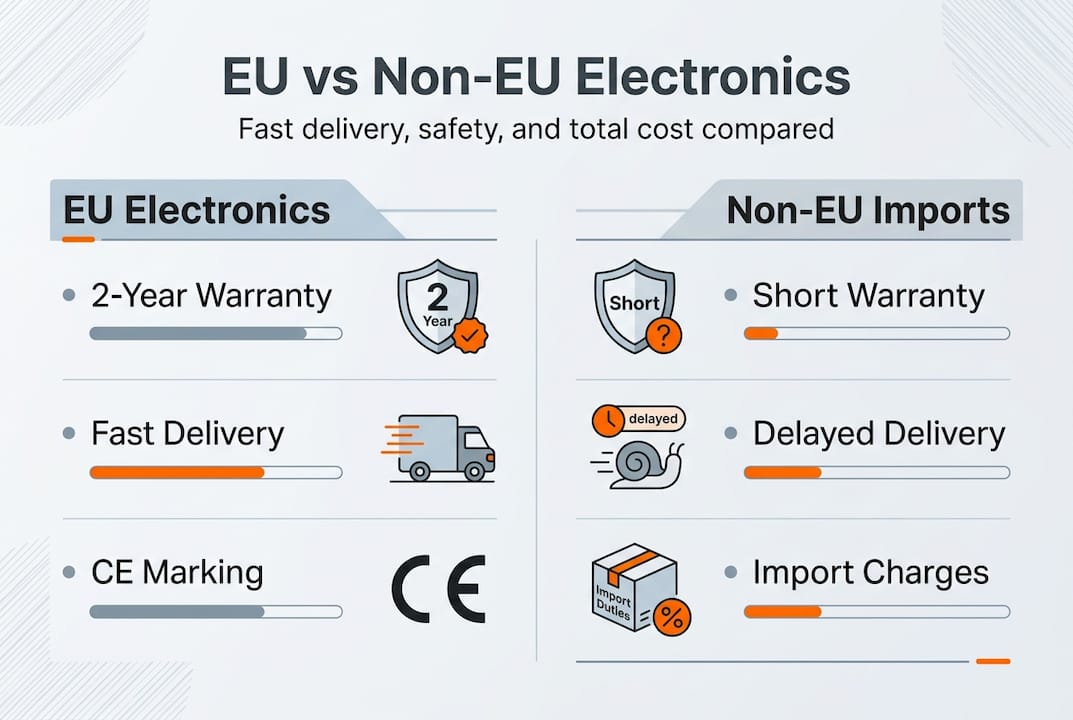
| Factor | EU electronics | Non-EU imports |
|---|---|---|
| Legal warranty | Minimum 2 years, enforceable | Varies, often unenforceable in EU |
| Product safety | CE, RoHS, REACH compliant | Compliance not guaranteed |
| Delivery speed | 1 to 3 days, no customs | 2 to 6 weeks, customs risk |
| Pricing transparency | Full price shown, VAT included | Hidden fees, duties, handling charges |
| Import duties (2026) | None for intra-EU sales | New duties apply, de minimis ending |
| Counterfeit risk | Very low | Significantly higher |
| Return process | Simple, 14-day right | Complex, often international shipping |
The total landed cost is the figure that matters most. Non-EU products may show a lower upfront price, but once you factor in duties, delays, and the absence of enforceable warranty rights, the value equation shifts clearly in favor of EU retailers. For a full purchasing framework, our complete 2026 EU buying guide covers every product category in detail. You can also browse our EU electronics buying guides and EU electronics tips 2026 for category-specific advice.
Shop smart: Find fast, safe EU electronics today
The evidence is clear. Buying electronics from EU-based retailers gives you stronger legal protections, safer products, faster delivery, and more predictable pricing than importing from outside the bloc. Now is the right time to put that knowledge to work.
At Online-Store24, we source every product from established European distributors and fulfill orders from EU-based warehouses, so you get the full benefit of EU consumer protections with every purchase. Whether you are looking for a reliable networking access point like the TRENDnet TEW-821DAP, a versatile TCL tablet with fast EU delivery, or any other technology product, you will find competitive pricing and transparent costs throughout our catalog. Browse our full EU electronics range and shop with confidence knowing your purchase is backed by EU law.
Frequently asked questions
What legal warranty do EU electronics have?
All electronics sold by EU retailers carry a minimum 2-year legal warranty, with free repair or replacement if the product is defective during this period.
Do EU electronics deliveries get delayed by customs?
Electronics shipped within the EU do not face customs delays. Only non-EU imports face customs checks, potential holds, and additional fees that can add weeks to delivery times.
Are refurbished electronics from EU retailers safe?
Yes. The EU refurbished market is tightly regulated, and certified refurbished products carry the same legal warranty protections as new items, along with competitive pricing and environmental benefits.
How do new 2026 import rules affect buying electronics from China?
From 2026, new EU import duties apply to low-value parcels from non-EU countries, ending the de minimis exemption and increasing the total cost of importing electronics from China significantly.
Is it really safer to buy electronics only from EU retailers?
Yes. 75% of hazardous electronics767224_EN.pdf) found in the EU are imported from outside the bloc, while EU retailers must comply with strict CE, RoHS, and REACH standards that minimize health and safety risks.