TL;DR:
- Eco-friendly appliances consider entire lifecycle impacts including materials, production, use, and disposal.
- EU regulations require minimum standards for efficiency, repairability, and recyclability of household appliances.
- Repairability, durability, and repair parts availability are crucial factors often overlooked in green appliance choices.
European households saved between €182 and €266 in 2020 thanks to tighter EU appliance efficiency rules. That's real money, not a projection. Yet most shoppers still struggle to tell the difference between a product that's genuinely eco-friendly and one that just carries a green label. The term gets used loosely, and that creates real confusion at the point of purchase. This guide breaks down what eco-friendly appliance design actually means, how EU regulations shape the products on your shelf, and what practical steps you can take to make smarter, more sustainable choices for your home.
Table of Contents
- What eco-friendly appliance design really means
- How EU eco-design rules shape your appliance choices
- Hidden complexities: What most people miss about eco-friendly appliances
- Making smarter choices: Practical steps for eco-conscious home upgrades
- Our take: Why the best eco-friendly choice isn't always the newest model
- Find your next eco-friendly upgrade with OnlineStore24
- Frequently asked questions
Key Takeaways
| Point | Details |
|---|---|
| Six design principles | Eco-friendly appliance design focuses on the entire product lifecycle for maximum environmental benefit. |
| EU rules guide choices | The EU Ecodesign Directive and Energy Label system ensure you can select genuinely efficient and repairable appliances. |
| Look beyond efficiency | Durability, repairability, and total footprint matter as much as raw energy savings for real sustainability. |
| Smart shopping steps | Check ratings, spare parts, and product modularity to make the best eco-friendly upgrade for your home. |
What eco-friendly appliance design really means
Eco-friendly appliance design is not just about low energy consumption. It means considering the environmental impact across the lifecycle of a product, from the raw materials extracted to make it, through manufacturing, daily use, and eventually disposal or recycling. That full-picture view is what separates genuinely sustainable design from surface-level green marketing.
There are six core principles that define this approach:
- Life cycle thinking: Every stage of a product's life is evaluated for environmental impact, not just the energy it uses in your kitchen.
- Resource efficiency: Using less water, energy, and raw material during both production and operation.
- Sustainable material choices: Prioritizing recycled content, responsibly sourced metals, and materials that can be recovered at end of life.
- Smart production: Reducing waste and emissions during manufacturing through cleaner processes and supply chains.
- Durability and repairability: Designing products to last longer and be fixed rather than thrown away.
- Information transparency: Giving consumers and repair technicians clear data about what's inside the product and how to maintain it.
In practice, these principles show up in ways you can actually see. Modular appliance designs, for example, allow you to swap out a faulty motor or control board without replacing the entire unit. Some manufacturers now use recycled plastic housing and clearly label which components can be separated for recycling. Exploring eco-friendly gadget principles in more detail can help you recognize these features before you buy.
Durability and repairability matter as much as energy efficiency. An appliance that lasts 15 years and can be repaired twice is often more sustainable than a highly efficient model replaced every five years.
This is a point that often gets lost. Efficiency ratings grab attention, but longevity is equally powerful. A washing machine that runs on slightly more electricity but survives 20 years of use may have a lower total environmental footprint than a top-rated model that breaks down and ends up in a landfill after eight.
How EU eco-design rules shape your appliance choices
The EU Ecodesign Directive sets legally binding minimum standards for energy efficiency, repairability, recyclability, and standby power consumption across a wide range of products. Dishwashers, refrigerators, washing machines, tumble dryers, televisions, and lighting all fall under its scope. If a product doesn't meet the directive's requirements, it cannot legally be sold in the EU market.
The EU energy label uses an A to G scale to rank appliance performance. An "A" rating today is genuinely demanding. When the current label system was relaunched in 2021, the top bands were deliberately left empty so manufacturers had room to innovate. This means you're unlikely to find many A-rated refrigerators or washing machines yet, but the scale gives you a clear benchmark for comparison.
| Label grade | What it means in practice |
|---|---|
| A | Highest efficiency, very few products qualify yet |
| B | Near top performance, among the best available |
| C | Good efficiency, above EU minimum standard |
| D | Average performance, meets baseline rules |
| E–G | Below average, may be phased out under future rules |
Here's how to use the label system effectively when shopping:
- Scan the QR code on the label to access the EPREL database, the EU's official product registry with verified performance data.
- Compare annual energy consumption figures, not just the letter grade.
- Check the product's rated capacity against your actual household needs.
- Look for standby and off-mode power figures, which the directive now limits strictly.
- Verify that spare parts are available for at least the minimum period required by law.
The directive also now mandates that manufacturers supply spare parts for a set number of years after a model is discontinued. For large household appliances, this is typically seven to ten years. That rule directly supports repairability and reduces the pressure to replace working appliances prematurely. Pairing this knowledge with a solid appliance shopping guide helps you apply these standards confidently at the point of purchase.
Hidden complexities: What most people miss about eco-friendly appliances
Beyond the labels and promises, there's a layer of complexity most shoppers aren't aware of. Not every eco-labeled appliance is as green as it appears, and the reasons are rooted in real data.
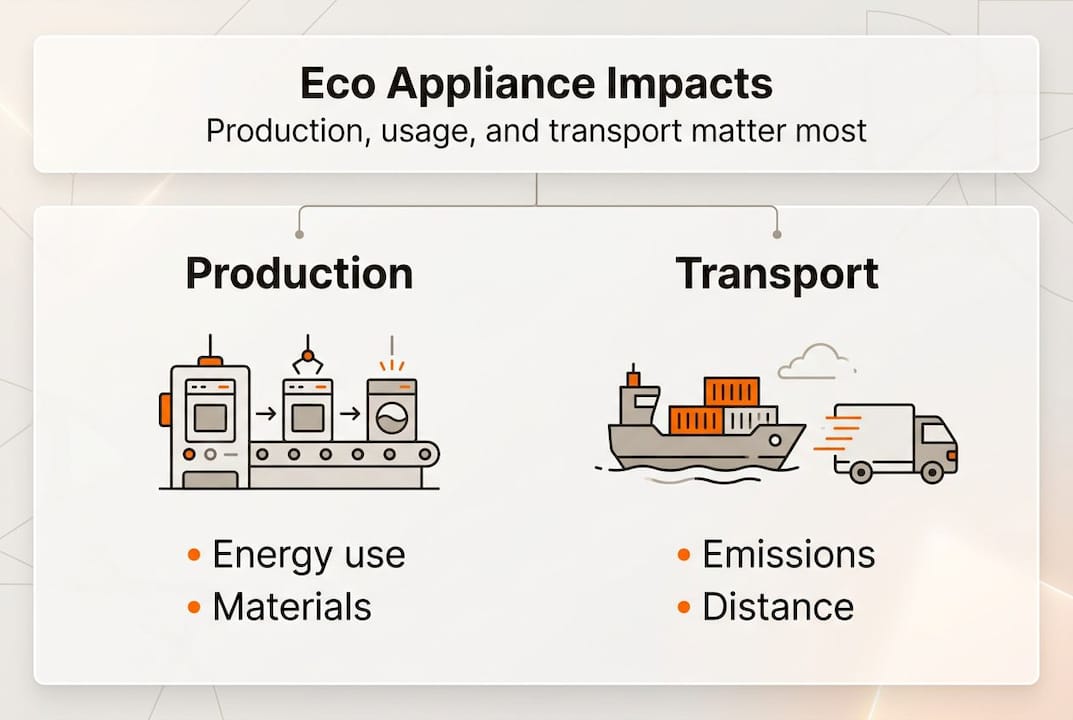
Production and transport emissions can dominate the total environmental footprint of an appliance, especially when the electricity grid in your country is already powered largely by renewables. If you live in a region with clean energy, the manufacturing phase of a new appliance may actually cause more harm than years of running your current one. This is what lifecycle assessment (LCA) research, which measures total environmental impact from production to disposal, consistently reveals.
There are also real trade-offs between durability and efficiency. Adding digital features, touchscreens, and connected sensors can make an appliance smarter but also harder to repair and more prone to software obsolescence. A washing machine with a simple mechanical dial may outlast a connected model with a touchscreen by five or more years. The EU Right to Repair legislation addresses this partly by requiring spare part availability, but it doesn't solve the problem of proprietary software locking out independent repair technicians.
| Feature type | Pros | Cons |
|---|---|---|
| Analog controls | Simple, repairable, long-lasting | Less precise, fewer features |
| Digital/smart controls | Efficient, programmable | Harder to repair, software risk |
| Modular design | Easy part replacement | Sometimes higher upfront cost |
| Sealed/integrated design | Compact, sleek | Difficult or impossible to repair |
Smart appliances can also quietly increase energy use. A refrigerator with a built-in screen and internet connection draws more standby power than a basic model, even if both carry the same label grade. Always check actual annual kilowatt-hour figures, not just the letter rating.
For a deeper look at what goes into the materials behind these products, the sustainable materials overview is worth reading. And if you're weighing up connected features, the smart appliance features guide covers what's genuinely useful versus what adds complexity without benefit.
Pro Tip: Before buying any appliance, search the manufacturer's website for spare part availability. If parts aren't listed or are discontinued within five years, that's a warning sign for long-term repairability.
Making smarter choices: Practical steps for eco-conscious home upgrades
Armed with real knowledge and a clear-eyed view of the pros and cons, here's how to upgrade your home sustainably. The goal is not perfection but informed decision-making that balances efficiency, longevity, and real-world cost.
Start with the EU Energy Label and EPREL database to benchmark any appliance you're considering. The QR code on the label links directly to verified performance data, including annual energy use, noise levels, and capacity. This takes less than a minute and gives you far more reliable information than marketing copy.
Here's what to check before committing to a purchase:
- Energy label grade: Aim for B or above on the current A to G scale for most appliances.
- Annual energy consumption (kWh): Compare models directly on this figure, not just the letter grade.
- Lifetime running cost: Calculate energy cost over ten years using your local electricity rate.
- Warranty length and spare part availability: Longer warranties and accessible parts signal durability.
- Repairability and modularity: Can you replace the pump, motor, or door seal without specialist tools?
- Recycled content and end-of-life labeling: Does the manufacturer disclose what materials are used and how to recycle them?
Timing also matters. EU regulations are updated regularly, and upgrading before new rules take effect can qualify you for higher rebates or incentives in some European countries. EU household savings from appliance efficiency improvements are projected to reach €473 to €736 per household by 2030, so acting sooner captures more of those cumulative savings.
For more ideas on what to prioritize, the energy efficient electronics guide covers specific product categories in detail. You can also browse the top modern appliances guide for curated options that meet current EU standards.
Pro Tip: Sometimes an older analog or high-quality model without smart features will outlast a connected alternative by years. If your current appliance still works well and parts are available, maintaining it may be the most sustainable option right now.
Our take: Why the best eco-friendly choice isn't always the newest model
There's a tendency in eco-conscious shopping to equate "new and efficient" with "better for the planet." We'd push back on that assumption. Based on what LCA data consistently shows, the production and transport of a new appliance can outweigh the marginal efficiency gains over your existing model, particularly if your current one still functions reliably.
The simplest products often win on sustainability. Fewer digital components mean fewer failure points, easier repairs, and longer service life. A basic refrigerator with a mechanical thermostat and no smart features may serve you for 20 years. A connected model with a built-in display may become obsolete when software support ends in seven.
We're not saying avoid efficiency upgrades. Replacing a genuinely old, inefficient appliance with a modern B-rated model is a clear win. But chasing the newest release every few years, even in the name of sustainability, can actually increase your household's total footprint. Look for repairability and build quality first, and treat the energy label as one factor among several. The smart ways to save without sacrificing guide explores this balance in practical terms.
Find your next eco-friendly upgrade with OnlineStore24
If you're ready to move from research to action, OnlineStore24 makes it straightforward. Our catalog is sourced from established European distributors and includes appliances and accessories that comply with current EU Ecodesign and energy labeling standards.

Not every upgrade means replacing a whole appliance. Exploring eco-friendly appliance accessories is a smart way to extend the life of what you already own. When you are ready for a full upgrade, you can browse all eco upgrades across our full range of home appliances, kitchen tech, and smart home devices, all delivered from EU-based warehouses with fast, reliable shipping across Europe.
Frequently asked questions
What makes an appliance eco-friendly?
An appliance is eco-friendly if it's designed for efficient energy and resource use, durability, repairability, and uses sustainable materials across its lifecycle. The six principles of eco-design provide the clearest framework for evaluating this.
How does the EU energy label help me choose eco-friendly appliances?
The EU energy label ranks appliances from A (most efficient) to G, giving you an at-a-glance benchmark for energy performance. Scanning the QR code on the label also connects you to the EPREL database for full verified product data.
Is it better to repair my old appliance or buy a new efficient one?
Repair is often the greener option if your appliance is durable and still functions well, but replacing a very inefficient older model can cut both bills and emissions more meaningfully over time. The right answer depends on your appliance's age, condition, and efficiency trade-offs.
What are the biggest hidden impacts of eco-friendly appliances?
Manufacturing and transport can generate higher emissions than years of daily use, especially when your local electricity grid is already clean. LCA research shows this is a frequently overlooked factor in sustainability assessments.
What regulations should I check for in 2026 when buying new appliances?
Look for compliance with the EU Ecodesign Directive, updated standby and off-mode power limits, and the current A to G energy labeling system. These standards set the legal floor for any appliance sold in the EU market.