
European electronics manufacturers have cut product failure rates dramatically through rigorous quality assurance programs. One documented case shows a manufacturer reduced its QC failure rate from 4% to 1.5% by combining targeted training with updated inspection technology. For quality assurance professionals and electronics manufacturers across Europe, this kind of result is not a lucky outcome. It is the direct product of systematic, well-structured QA frameworks applied at every stage of the product lifecycle. This article walks you through the core principles, standards, processes, and expert strategies that make that level of improvement achievable.
Table of Contents
- Why quality assurance matters in electronics manufacturing
- Building a quality framework: Standards and certifications
- Key processes for quality assurance: From design to delivery
- Expert insights: Advanced QA strategies and performance benchmarks
- Practical steps: Applying quality assurance best practices
- Reliable electronics: Find certified products and tools
- Frequently asked questions
Key Takeaways
| Point | Details |
|---|---|
| QA prevents defects | Quality assurance minimizes failures by embedding systemic prevention across processes. |
| Standards ensure reliability | Certifications like ISO 9001 and IPC-A-610 guarantee consistent electronic product quality. |
| Expert methods boost outcomes | Integrating Robustness Validation and machine vision greatly reduces defect rates for manufacturers. |
| Continuous improvement is vital | Regular training, audits, and updated QA frameworks drive ongoing gains in reliability and customer satisfaction. |
Why quality assurance matters in electronics manufacturing
Quality assurance and quality control are often used interchangeably, but they serve very different functions. Understanding the difference between QA and QC is the first step toward building a more effective program. QA is prevention-oriented. It focuses on designing and managing processes so that defects are unlikely to occur in the first place. QC, by contrast, is detection-oriented. It catches defects after they have already happened.
QA in electronics manufacturing focuses on systematic prevention of failures rather than reacting to them. This distinction matters enormously for profitability. Every defect caught late in production costs significantly more to fix than one prevented at the design stage. Defects that reach customers cost even more, in returns, warranty claims, and damaged brand reputation.
Robust QA programs directly support improved customer satisfaction by reducing the likelihood of product failures in the field. They also support electronics reliability strategies that extend product lifespans and reduce total cost of ownership for end users. The business case is clear.
Key benefits of a robust QA program include:
- Fewer product returns and warranty claims
- Stronger brand trust and customer loyalty
- Lower production costs through early defect prevention
- Faster time to market with fewer late-stage rework cycles
- Easier compliance with EU regulatory requirements
"A prevention-first approach to quality assurance consistently outperforms reactive inspection models in both cost efficiency and customer satisfaction outcomes."
Investing in preventing defects in electronics at the process level is always more cost-effective than managing failures after the fact.

Building a quality framework: Standards and certifications
European electronics manufacturing operates within a well-defined landscape of standards and certifications. Knowing which ones apply to your products and markets is essential for building a credible QA framework.
ISO 9001 is the foundational quality management standard applicable across industries. It establishes requirements for a quality management system (QMS) focused on consistent process control and continuous improvement. ISO 13485 applies specifically to medical electronic devices, with stricter documentation and traceability requirements. IPC-A-610 defines acceptability criteria for electronic assemblies, with Class 3 being the benchmark for high-reliability applications. European practices emphasize IPC Class 3 for assemblies where failure is not an option, such as aerospace, automotive, and medical electronics. RoHS (Restriction of Hazardous Substances) governs material compliance across the EU. ZVEI Robustness Validation provides application-specific guidance for ensuring components perform reliably under real-world stress conditions.
| Standard | Scope | Key requirement |
|---|---|---|
| ISO 9001 | All industries | Process-based QMS |
| ISO 13485 | Medical devices | Strict traceability |
| IPC-A-610 Class 3 | High-reliability assemblies | Zero-defect assembly criteria |
| RoHS | EU market products | Hazardous substance limits |
| ZVEI Robustness Validation | Component reliability | Application-specific stress testing |
Certification to these standards is not just a compliance checkbox. It signals to customers, partners, and regulators that your processes are auditable and repeatable. You can explore EU sustainability certifications and reliable electronics standards to understand how certification choices affect product positioning.
Traceability is a core requirement across most of these frameworks. Every component, process step, and inspection result should be documented and linked to a specific production batch. This makes root cause analysis faster and recall management far more manageable.
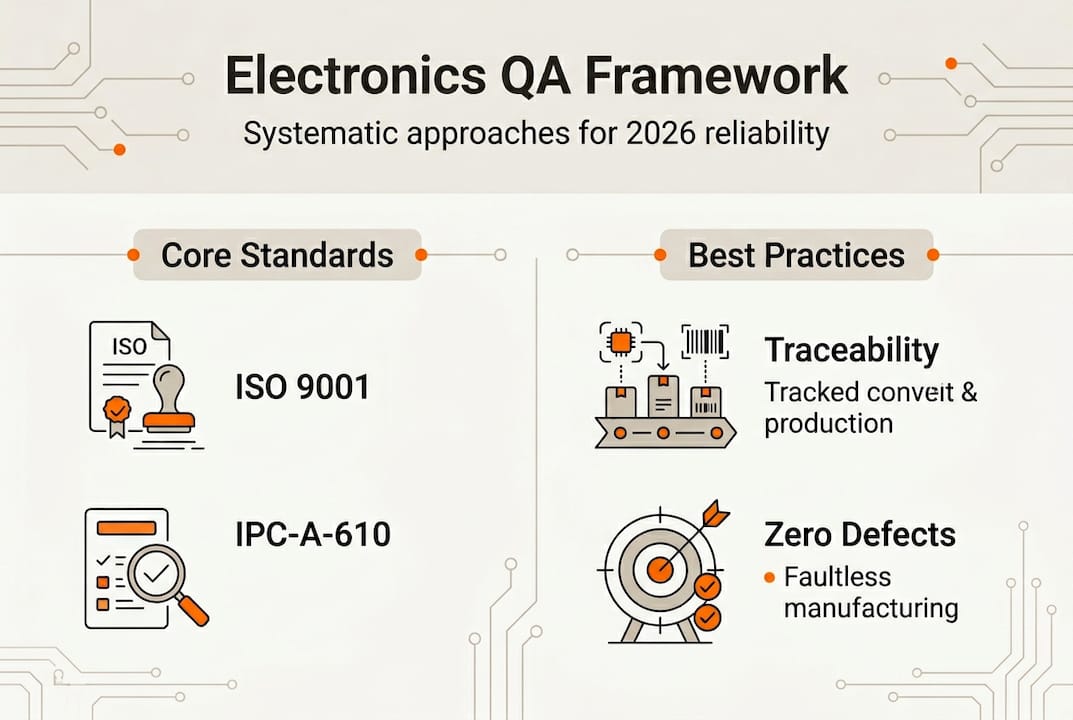
Pro Tip: Use Robustness Validation best practices as the foundation of a zero-defect strategy. By testing components to their application-specific stress limits rather than generic spec limits, you identify failure mechanisms before they appear in the field.
Key processes for quality assurance: From design to delivery
Effective QA is not a single inspection step. It is a sequence of coordinated processes that span the entire product lifecycle. Key methodologies include multi-stage inspections, statistical process control (SPC), automated optical inspection (AOI), in-circuit testing (ICT), and environmental stress testing.
Here are the core QA process stages from concept to delivery:
- Design review: Conduct design for manufacturability (DFM) analysis to identify potential failure points before production begins.
- Supplier qualification: Audit suppliers against defined quality criteria. Verify material certifications and conduct incoming inspection of critical components.
- Process control: Implement SPC to monitor production variables in real time. Set control limits and respond to deviations before defects occur.
- In-process inspection: Use AOI and ICT to catch assembly errors at the board level. Environmental testing (thermal cycling, humidity, vibration) validates performance under stress.
- Final inspection: Conduct functional testing on finished products. Verify compliance with applicable standards before release.
- Delivery and field monitoring: Track field returns and warranty data. Feed findings back into the design and process improvement cycle.
Counterfeit component prevention deserves special attention. Supply chain variability is a real risk in global electronics sourcing. Supplier audits, approved vendor lists, and advanced electrical and visual checks are your primary defenses. You can review supplier audit strategies for practical guidance on structuring these programs.
| QA stage | Primary tool | Key output |
|---|---|---|
| Design | DFM analysis | Reduced failure risk |
| Supplier | Audit and incoming inspection | Verified material quality |
| Production | SPC, AOI, ICT | Real-time defect prevention |
| Environmental | Thermal, humidity, vibration tests | Stress performance data |
| Final | Functional test | Release-ready product |
Pro Tip: Machine vision systems now achieve 99% defect detection accuracy on surface-mount assemblies. Integrating machine vision at the AOI stage significantly reduces false escapes compared to manual inspection alone.
Expert insights: Advanced QA strategies and performance benchmarks
Leading manufacturers are moving beyond standard QA frameworks toward more sophisticated approaches. Robustness Validation targets failure mechanisms at application-specific stress limits, using a test-to-fail paradigm that reveals how much margin exists between normal operating conditions and actual failure. This is a significant shift from traditional pass/fail testing against generic specifications.
The results speak clearly. First-pass yield (FPY) rates of 95 to 98% are achievable in well-optimized SMT (surface-mount technology) production lines. Defect rates below 2% are realistic targets for manufacturers who integrate QA systematically from the design stage onward. These are not theoretical benchmarks. They reflect what leading European manufacturers are achieving today.
"Zero-reject manufacturing is not a slogan. It is the result of applying Robustness Validation, rigorous process control, and continuous improvement disciplines simultaneously across the entire supply chain."
Common QA pitfalls that undermine these results include:
- Treating QA as a final inspection step rather than a process-wide discipline
- Failing to document and act on field return data
- Relying on supplier self-certification without independent audits
- Underinvesting in team training, especially for new inspection technologies
- Skipping environmental stress testing for cost reasons
You can review process improvement results from manufacturers who have addressed these pitfalls systematically. The data consistently shows that early QA integration and technology investment deliver the strongest returns. Explore application-specific reliability testing to understand how these strategies apply across different product categories.
Practical steps: Applying quality assurance best practices
QA drives customer satisfaction by reducing returns and recalls. The best practice is to integrate QA from the design phase and invest in both team training and AI-powered inspection tools. Here is how to put that into practice.
- Start at design: Involve QA engineers in design reviews. Identify failure modes early using FMEA (failure mode and effects analysis) before tooling is committed.
- Qualify your suppliers: Build an approved vendor list. Conduct on-site audits for critical component suppliers. Require material certifications and traceability documentation.
- Implement SPC on key process parameters: Monitor solder paste volume, reflow temperature profiles, and component placement accuracy. React to trends before they become defects.
- Invest in inspection technology: AOI, X-ray inspection, and machine vision systems pay for themselves quickly when measured against the cost of field failures.
- Train your team continuously: Technology is only as effective as the people operating it. Regular training on new inspection methods and quality standards keeps your team sharp.
- Close the feedback loop: Analyze field return data monthly. Map failures back to specific process steps or suppliers. Use this data to drive targeted improvements.
Keys to continuous improvement:
- Set measurable QA targets (FPY, defect rate, return rate) and review them quarterly
- Benchmark against industry standards and peer manufacturers
- Engage cross-functional teams in root cause analysis
- Reward proactive defect identification, not just defect correction
- Explore cost-effective quality strategies that balance investment with measurable outcomes
For a broader view of how QA connects to customer-centric QA practices, consider how your QA program communicates reliability to end users. Certification marks, warranty terms, and return policies all signal quality to buyers.
Reliable electronics: Find certified products and tools
Applying rigorous QA frameworks starts with sourcing products and components that already meet high reliability standards. At Online-Store24, we source electronics from established European distributors and fulfill orders through EU-based warehouses, so you can be confident in the provenance and compliance of every product.

Whether you need certified access points for network infrastructure, quality graphics tablets for design and engineering teams, or a broader selection of technology tools, our catalog is built around verified, reliable products. Browse more certified electronics across our full range to find solutions that align with your quality and compliance requirements. We make it straightforward to source electronics that support your QA goals from the very first step.
Frequently asked questions
What is the difference between quality assurance and quality control in electronics?
Quality assurance is prevention-oriented, focusing on building processes that stop defects from occurring, while quality control is detection-oriented, identifying defects through inspections and tests after production steps are complete.
Which standards are most important for quality assurance in EU electronics manufacturing?
Key standards include ISO 9001 for general quality management, IPC-A-610 Class 3 for high-reliability assemblies, RoHS for environmental compliance, and ZVEI Robustness Validation for application-specific reliability testing.
How do manufacturers reduce defect rates and improve customer satisfaction?
Manufacturers achieve lower defect rates by integrating QA from the design stage, training teams on current inspection methods, and deploying technologies like machine vision and AI-powered inspection that consistently deliver defect rates below 2%.
What is Robustness Validation and why does it matter?
Robustness Validation is an application-specific QA methodology that tests components to their actual failure limits rather than generic specification limits, revealing real reliability margins and preventing field failures that standard tests would miss.
How can supply chain variability and counterfeits be managed in electronics QA?
Counterfeit risks and supply chain variability are best managed through structured supplier audits, approved vendor lists, mandatory traceability documentation, and advanced visual and electrical checks at incoming inspection stages.
Recommended
- Maintain home electronics for longer life in Europe 2026
- Best Electronics for Modern Homes in Europe (2026 Guide) – OnlineStore24 EU
- Smart consumer electronics tips for Europe 2026 | OnlineStore24 EU - Envío Rápido
- Advantages of consumer electronics for European homes 2026 | OnlineStore24 EU - Envío Rápido